
Host guide
Power, base and permits before you order
October 30, 2026
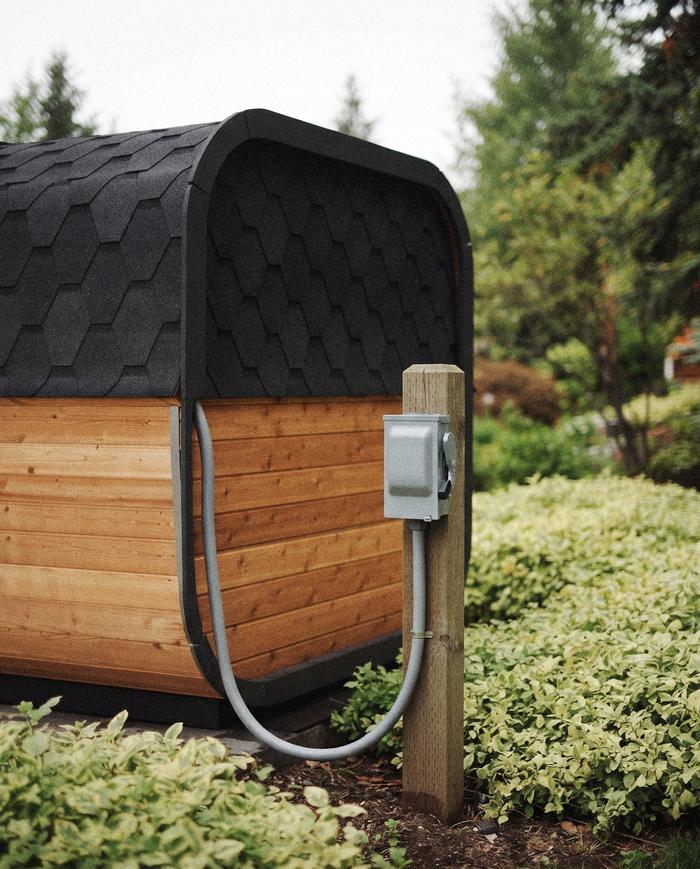
An outdoor sauna is a small building with a large electric heater in it. Three things hold up an install when nobody checks them before the freight truck turns up: the power, the base and the paperwork. Here is what to line up, and who to ask.
This is general information to help you ask the right questions. It isn't legal, electrical or insurance advice. Your electrician, your local building department and your insurer have the final word for your site.
Power
What the heater needs
Every electric heater we sell runs on 240V. The breaker size depends on the heater:
- HUUM DROP 4.5 kW: 240V single phase, 18.75 amps, a 30 amp breaker and 10 AWG wire.
- HUUM DROP 6 kW: 240V single phase, 25 amps, a 30 amp breaker and 10 AWG wire.
- HUUM DROP 9 kW: 240V single phase, 37.5 amps, a 50 amp breaker and 8 AWG wire.
- Golden Designs saunas: the maker lists 240V / 40 amps for the stove. The Arlberg, Vorarlberg, Kaarina and Klosters also list a 120V / 15 amp circuit for the lights control (lights and music on all but the Klosters).
- Harvia Cilindro PC60E: 6 kW, 240V single phase.
The Golden Designs cold plunge is the exception. It plugs into a standard 110V outlet, with GFCI built in.
Questions for your electrician
Send your electrician the product page and the maker's manual before you order, then ask:
- Does the main panel have room and capacity for another 240V breaker of this size?
- How far is the panel from the sauna spot, and what wire and trenching does that distance need?
- Does local code want a disconnect near the sauna, GFCI protection, or anything else for an outdoor install?
- Does the work need a permit and an inspection here?
Get the quote in writing. It goes straight into the install line of the payback calculator.
No 240V at the site
If running a 240V circuit isn't practical, a wood stove is the other route. The HUUM HIVE Wood 13 is a 13 kW wood-fired stove for rooms of 212 to 459 cu ft. It needs a chimney connection, and wood stoves come with their own rules on flues, clearances and burn days. Ask us which sauna can take it before you order.
Base
Level, firm and drained
Every sauna needs a level, firm base that can carry its weight plus the people inside, and somewhere for water to go. Common choices are a concrete pad, pavers on compacted gravel, or a deck built to carry the load. The maker's manual sets the details, so give it to whoever builds the base.
Some kits come with part of the foundation. The SaunaLife Cube CL3G includes foundation cradles, the CL12GCP includes foundation beams, the Garden cabins include a ground frame, and the Ergo barrels sit on cradles. The Ergo barrels also have two floor drains, so plan where that water ends up.
Use the shipping weight as a guide when you talk to the builder. It runs from 795 lbs for the Golden Designs Klosters to 3,450 lbs for the SaunaLife Cube CL12GCP.
Space around it
Measure the outside footprint on the product page, then leave room to walk around it, open the door fully and reach the heater for upkeep. If the sauna has a roof overhang, the footprint with the overhang is the one that counts.
The route from the curb
Freight is delivered curbside. The driver doesn't carry it to the site. Check that a large truck can reach your curb and stop safely, and plan how the crates and parts get from there to the base. The CL12GCP ships in a crate 155 inches long.
Permits and paperwork
Rules depend on your town, county and state, and they change. Ask before the sauna arrives, not after.
- Building department: does an outdoor sauna of this size count as an accessory structure here? Does it need a building permit, and what setbacks from property lines apply?
- Electrical permit: your electrician will usually know whether the new circuit needs a permit and an inspection.
- HOA or landlord: are outdoor structures allowed, and do they need sign-off?
- Short-term rental rules: does your local rental permit or license say anything about amenities like saunas or plunges?
- Insurer: does your policy cover a sauna or a cold plunge used by paying guests? What do they want from you, such as signage or house rules?
- The maker's warranty: does it cover commercial use? See our rental warranty facts.
Keep the answers in writing, with the date and the name of the person you spoke to.
A short checklist
- Product page and manual sent to the electrician; written quote back.
- Panel capacity, breaker size and wire run confirmed.
- Base type agreed, sized to the footprint, level and drained.
- Delivery route from the curb planned.
- Permit questions answered by the building department, HOA and insurer.
- Warranty terms read for the brand you're choosing.
When those six are done, ordering is the easy part. If you're stuck on any of them, send us the details and we'll tell you what we know.